Oh boy! You’ve got your first teaching job or you’ve just been given a new prep and it’s American Lit. Welcome to the most challenging and awesome year of your career.

I don’t know what your state does, but American Lit in Alaska is taught to Juniors and is paired with US History. If you’re lucky, you’ll have a social studies teacher who you can team teach with to make sure you’re always on the same era, and that students have the historical context to access the texts you want to study. If you’re REALLY lucky, you might have a humanities block and you are also your student’s social studies teacher. But for most of us, we are at a large school and our American Lit students might have US History with four or five other teachers who all have their own style, pacing, and preferences. When this happens, you end up doing a lot of the front loading which is a double-edged sword. You spent some time in class doing things that aren’t perfectly aligned to your curriculum, sure, but I find that sometimes the skills required of gaining historical context are just as important and tie right in with studying the historical text itself.
Another fun facet of American Lit for me is that this is the year that many students leave their traditional English course for AP Lang, which means that a lot of students in my traditional American Lit course suddenly don’t have the high flyers leading class discussions and taking over group projects. This power vaccum changes the dynamic a lot and you’ll see some students who have not stepped up previously speaking up for the fist time in class discussions and starting to come into their own in the absence of their often louder peers.
The final facet here is the new fear of “Critical Race Theory.” There is a lot of big words and angry sentiments being tossed around about this, and there probably are some people who are taking it too far. But if you’ve ever asked students to examine perspectives other than their own, and consider the implications of race, society, and culture in a text, you’ve probably “taught” CRT without even realizing it. CRT is not ignoring the white, middle-class perspective in literature. It’s simply considering that it’s not the only perspective in our country, and looking at literature that highlights these issues and giving them some time in your curriculum in addition to the “classics.”
What does this mean for you, teaching American Lit? Well, you’ve got a lot of moving parts to gracefully braid together into a cohesive classroom environment that encourages academic discussion, consideration of multiple perspectives, and preparing students to have tough conversations where they defend their points while still considering others. For a lot of teachers who have Huckleberry Finn or other Mark Twain texts in their American Lit curriculum, this means having some tough conversations.
Some teachers are now choosing to skip Huck Finn entirely in favor of texts by more diverse authors. I think that’s a mistake. I don’t advocate for reading the entire book though. I like to continue to include Huck by demonstrating common core standards in researching Mark Twain and his historical context, reading articles about the reception and censorship of Huck Finn, studying a few whole chapters for theme analysis and character development, and then watch the 1993 film as part of a film study and the impact of adapting to film on the meaning of the text. Plus kids just really love seeing a baby Frodo in Elijah Wood’s performance 🙂
If this approach seems interesting or do-able to you, consider trying some of my resources for pre-teaching the novel.
Mark Twain Historical Context for Huck Finn with the N-Word Censorship Analysis
Here’s a description of the resource:
Can Huckleberry Finn still be taught in this climate? Was Mark Twain a racist? How can we justify teaching a book that uses the n-word 219 times?!
These are all tough questions, but my answer is yes, no way, and yes, with thoughtfulness and an open heart. This resource is one way to start that process.
This is actually three smaller lessons in one file.
The first is a historical context of Mark Twain’s life and writings. Students will research his upbringing, his involvement in the civil war, and the context of his writings. The biggest thing to understand when studying Huck Finn is that it was written AFTER the civil war, during reconstruction, but set pre-civil war and is generally recognized as a critique of the failings of reconstruction. If students miss that essential context, it’s easy to see this book as a racist example of a racist time and nothing more.
The second resource is a one page compare and contrast video where students can watch the original Crash Course US History on reconstruction and then the Crash Course Black American History on the same subject and compare and contrast. It also gives them space to reflect on if they want more John Green or more Clint Smith if you watch Crash Course US history again.
The last activity is four pages that has students reflect on the use of the n-word in Huck Finn, the history of Huck Finn’s censorship, the history of the n-word, and other perspectives on the conversation. Students will analyze four articles and a video that explore these topics and end with a personal response on how they feel about the word and who, when, and where it should be said.
If they understand the context and practice of this text, and are able to analyze these tough concepts in a safe environment, they will be more prepared to these tough conversations as they head into adulthood.
If you’re agreeing with what I’m saying, but are nervous to teach this text, these resources may be helpful to you. I know this is a spicy and sensitive topic in the “critical race theory” world we are living in, but I believe in tackling the tough subjects and putting kids in environments where they have to think critically and defend or reconsider their perspectives. We’re doing them a disservice if we are avoiding those situations.
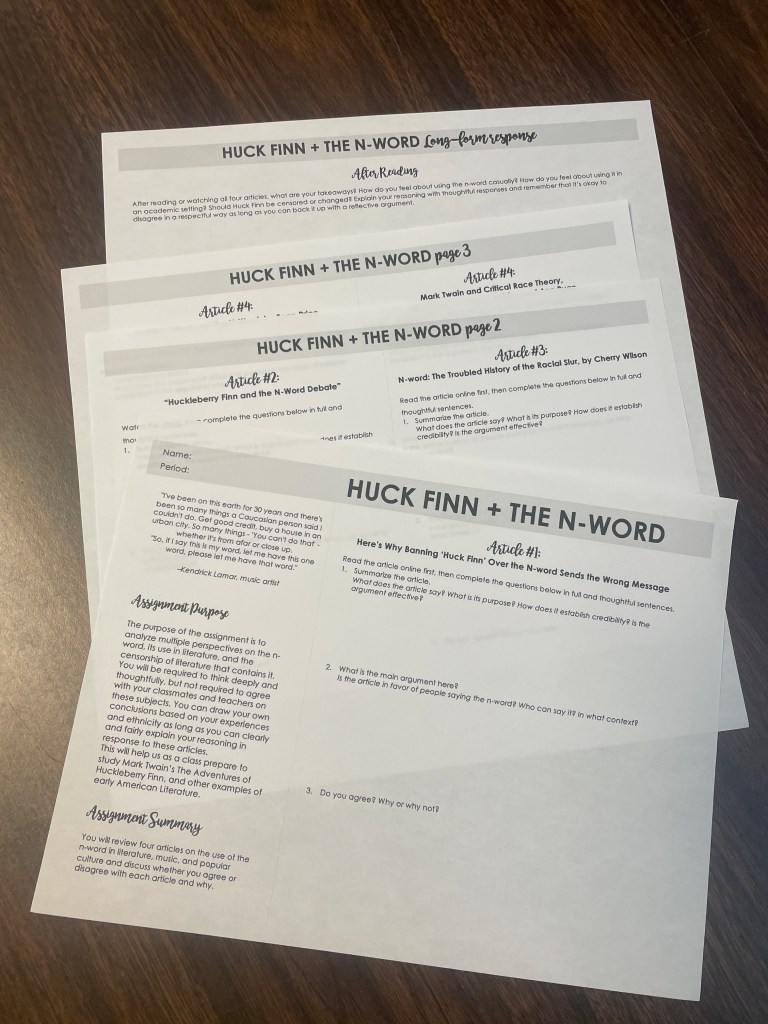
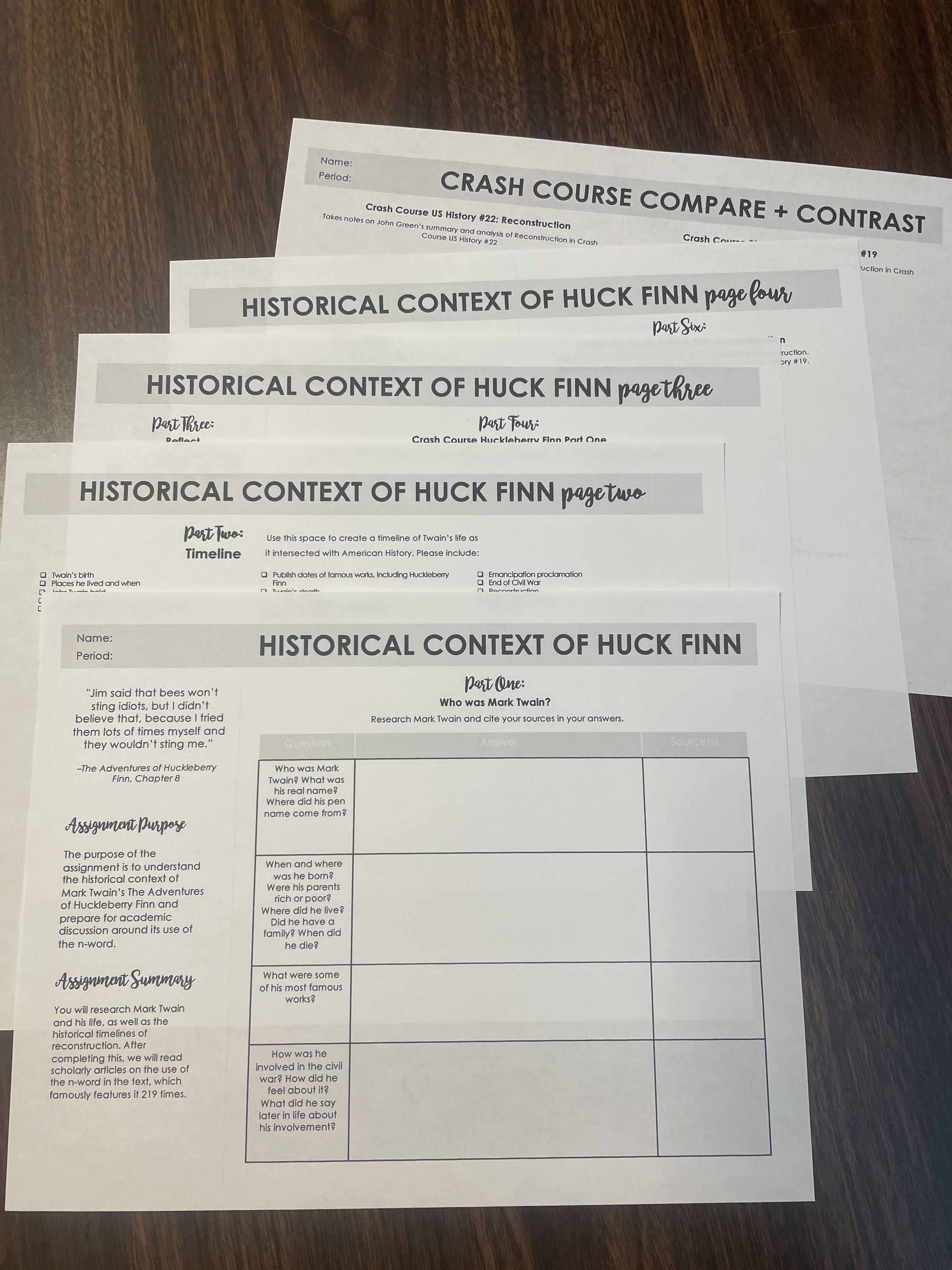
If you’re interested in this resource, but want to learn more, here is a list of the articles and video included in the n-word analysis:
Here’s Why Banning Huck Finn Over the N-Word Sends the Wrong Message
”Huckleberry Finn” and the N-Word (Heads up, this video says it in its entirety several times)
N-Word: The Troubled History of the Racial Slur
Straight Talk About the N-Word
Mark Twain and Critical Race Theory (opinion)
Overall, teaching this text and many others like it in American Lit can be stressful or, if you don’t do the hard work, a waste of time for all involved. I’ve been teaching this lesson in one form or another for four years, but it took a lot of reflection and chatting with my teacher friends to decide how and when to share it with teachers around the country. The whole American Lit curriculum and its place in our education system has put me in some of the most challenging positions in my career, and I am grateful for those moments. If you’re nervous to approach these topics, that is OK and very normal. I want to encourage you, however, to lean in and be prepared for those challenges because those are the kind that help you decide what kind of teacher you’re going to be and what your educational philosophy is. I hope some of you find this helpful in starting these big conversations in your classroom. God speed!
 HeyKenna